
Gothenburg leads the way in medical simulation
Thanks to advanced simulation technology, doctors can improve their surgical skills more quickly and safely. The technique benefits both patients and society as a whole. Gothenburg-based companies Surgical Science and Mentice are among those driving the development.
Maria Zeaiter and Abdelaziz Al-Habali have worked together to thread a thin metal wire, a guidewire, through a long plastic tube. On a screen in front of them, Maria guides the tube, a catheter, through the aorta and towards the heart. Carefully, she advances the guidewire into a coronary artery before sliding a second tube, fitted with a balloon made from durable plastic, over the guidewire. Abdelaziz Al‑Habali injects contrast fluid and adjusts the manometer in his hands. The rising pressure is visible as the balloon expands.
But there is no patient in front of them, and they are not in an operating theatre. They are in the lecture hall “Förmaket” at Sahlgrenska University Hospital. The entire procedure is simulated.
It’s very useful to train in this way at the start of your career. It means you recognise the situation when you are standing at the operating table for the first time.
Training surgeons before live procedures
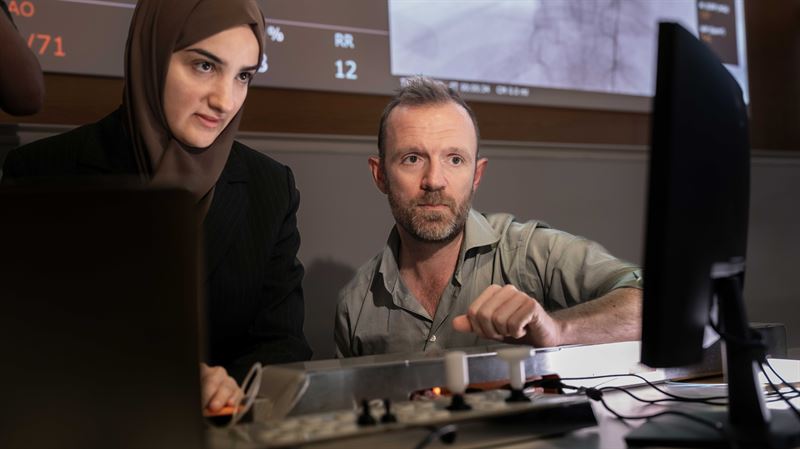
Maria Zeaiter and Abdelaziz Al‑Habali are specialist trainee doctors attending a course in Gothenburg together with around forty other future cardiologists from across Sweden. Over five days, they receive an introduction to interventional cardiology. Half a day is allocated to practising, in a safe setting, how to treat a patient suffering from angina or possibly a heart attack.
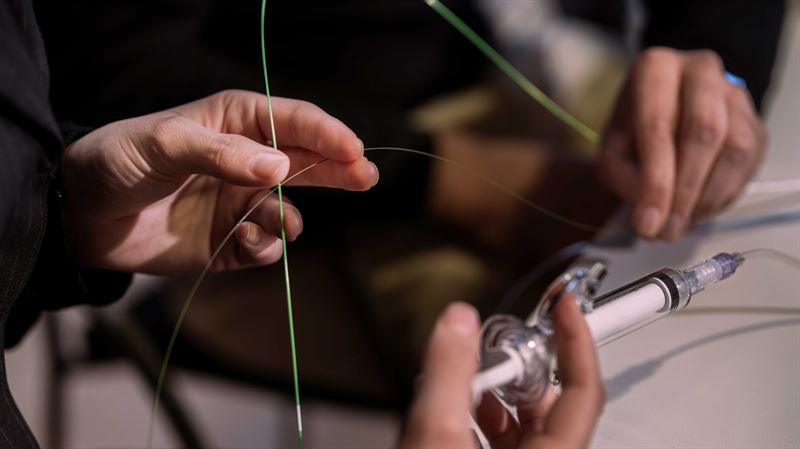
“It’s very useful to train in this way at the start of your career. It means you recognise the situation when you are standing at the operating table for the first time,” says Oskar Angerås, cardiologist at Sahlgrenska and one of the course instructors.
The simulation equipment in use is provided by Mentice, a Gothenburg company specialising in simulation solutions for image‑guided interventional therapy, or IGIT. Interventional procedures are minimally invasive and, in this case, involve endovascular surgery. This means operating through blood vessels using catheters and guidewires, rather than through open surgery via the chest.
"Allowing doctors and clinical teams to practise in a realistic environment improves patient safety. Compare it with the aviation industry, where pilots must train in simulators and regularly renew their certification"
Martin Harris, Vice President Marketing på Mentice
“Allowing doctors and clinical teams to practise in a realistic environment improves patient safety. Compare it with the aviation industry, where pilots must train in simulators and regularly renew their certification,” says Martin Harris, Vice President of Marketing at Mentice.
He continues:
“These products are remarkable, for patients and for the medtech industry, indeed for the whole world. So… why are we still relatively unknown?”
Two companies with the same roots
His question needs context. The company operates in a niche that is still relatively small. But both Mentice and Surgical Science, another Gothenburg firm in the same sector, have significant room for growth. Both are world leaders.
The two companies also share the same origins. They emerged from the remains of Prosolvia, a company that, during the 1990s, was at the forefront of advanced computer simulation and virtual reality. Prosolvia went bankrupt in 1998, but key expertise was carried forward when some employees founded new companies.
“Surgical Science originally began as a collaboration between Prosolvia and Sahlgrenska University Hospital. We were based at the Medicinareberget campus and funded by GU Ventures,” says Anders Larsson, one of three co-founders and now long-serving Chief Technology Officer at Surgical Science.
He continues:
“We were early in recognising the value of medical simulation and had to create our own market. We started by developing simulation equipment for laparoscopy - keyhole surgery. Having access to surgical expertise at Sahlgrenska was crucial. We could conduct validation studies to demonstrate that the equipment delivered the results we promised.”
Both companies were founded in 1999 and grew steadily throughout the early 2000s, both organically and through acquisitions. Surgical Science was listed on the stock market in 2017, and Mentice followed in 2019.
"Hopefully, the major insurance companies in the US can help to make certification a requirement, so that simulation technology goes from something that is good to have to a must"
Anders Larsson, co-founder and technical director at Surgical Science
Mentice has concentrated on establishing a strong position in endovascular simulation. Surgical Science also works in that field, but additionally in ultrasound, robotic surgery and endoscopy. Robotic surgery uses a computer‑assisted robotic system to perform operations. The surgeon remains in full control, but gains added precision and stability. Endoscopy is a collective term for examinations in which a thin tube with a camera and light is inserted into the body to inspect organs, take tissue samples or perform surgery – such as gastroscopy (via the mouth to the stomach) or colonoscopy (via the rectum to the large intestine).
Assessing performance and planning with AI
Both companies offer hardware in the form of digital simulators, as well as software for medical training. The objective is for surgeons and other healthcare staff to practise handling instruments and carrying out procedures in a safe, virtual environment. Better‑trained staff leads to enhanced patient safety and more efficient healthcare. Robotic surgery has also been shown to reduce recovery times and the risk of complications.
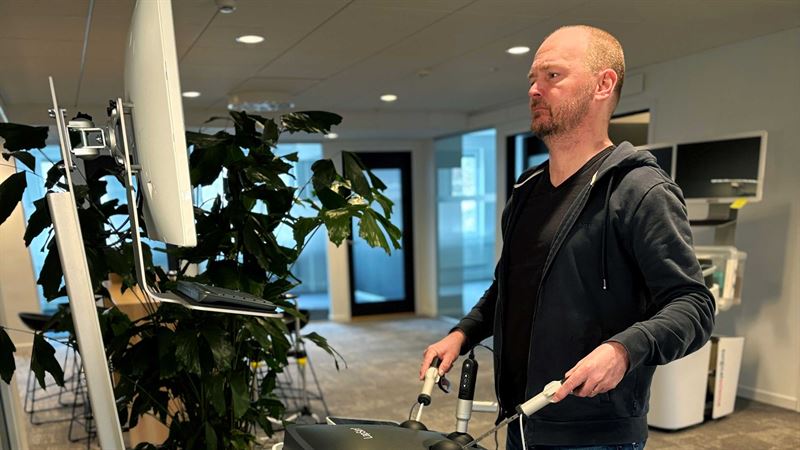
At Surgical Science’s facilities in Gårda, a showroom allows demonstrations, and opportunities for visitors to try the simulators for themselves. Anders Larsson approaches the LapSim system, used for laparoscopy, and selects a programme for gallbladder surgery.
“I’m going to remove the gallbladder and seal off the blood vessels leading into it,” he explains.
He takes hold of the two controllers, a “grasping tool” and “scissors”. The virtual operation appears on the screen.
“There are bile ducts and blood vessels here that you don’t want to damage. This is often one of the first procedures a trainee doctor performs, and the simulator allows you to practise, for instance, avoiding cutting the gallbladder with the scissors during a real operation.”
Thanks to AI and advanced image recognition, it is now becoming possible to analyse what actually happens during a real surgical procedure; for example, how a surgeon moves their instruments. Using this material, one can assess performance and identify ways to improve.
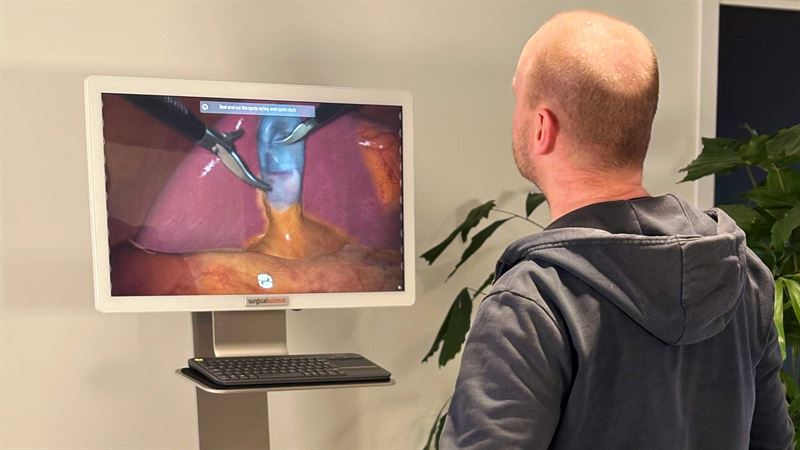
“Simulators provide the perfect environment for this. It becomes a form of circular training. The principle is similar to using analysis tools to break down what happens during a football match. Here, surgeons can practise specific steps in a procedure and then measure how they improve. I believe we are at the start of a shift, and this type of training will become far more common,” says Anders Larsson.
Mentice also sees significant potential in AI.
“It can be an excellent tool for optimising software and helping doctors plan and rehearse procedures. They use our equipment to improve their ability to save lives, so the potential is tremendous. We have also started offering clinical‑planning solutions, allowing procedures for individual patients to be simulated in advance,” says Martin Harris.
Gothenburg matters
Both Mentice and Surgical Science work closely with the medical technology industry, developing tailored software and training their customers’ customers. Their markets are global, though the US and Europe remain the most important. The companies also collaborate directly with hospitals and training centres. Proximity to Sahlgrenska is, as mentioned, a major advantage - and there are further benefits to being headquartered and developing technologies in Gothenburg.
“There is a wealth of expertise here,” says Martin Harris. “You have Chalmers University of Technology, companies like AstraZeneca and Mölnlycke, and actors in both the automotive and gaming industries. Many of our developers actually come from game studios.”
He adds:
“Another advantage is the closeness to nature and the opportunity for a good work–life balance. On the whole, we keep fairly normal office hours.”
AI is changing the overall economy
The development in medical simulation is part of a much broader shift where AI is driving rapid convergence between life science, healthcare, industry at large, and digital technology.
"In Gothenburg, we see how AI is used far beyond simulation, from clinical decision support, image analysis and individualized treatment planning to digital twins, often through expertise from the gaming, automotive and IT sectors meeting healthcare and education. This development affects the entire economy," says Iris Öhrn, investment advisor in life science at Business Region Göteborg.
"Regions that, like us, can work cross-sectorally and quickly translate advanced AI into practical application will have a clear head start on the national economy"
Iris Öhrn, Investment Advisor in Life Science at Business Region Göteborg
The shift is also reflected in international cooperation. Business Region Göteborg has just participated in an industry-led delegation to a global AI summit in New Delhi, led by Marcus Wallenberg.
"Regions that, like us, can work cross-sectorally and quickly translate advanced AI into practical application will have a clear head start," says Iris Öhrn.
But in global competition, there are also challenges. Both Martin Harris and Anders Larsson mention infrastructure – for globally oriented companies, the flight connections at Landvetter Airport are insufficient. And they stress the fierce competition for talent.
Want to see simulation being compulsory
Yet both believe they hold a trump card. Anders Larsson explains:
“Our products have a higher purpose compared with many other industries. We’ve seen that this matters, especially to developers who have been in the field for a few years. Everyone has some connection to healthcare and understands its importance. And the more talent there is to recruit, the better. We want to grow everywhere – but especially here in Gothenburg.”
The biggest challenge though – the one that stands in the way of a real leap in growth – is that simulators are still not standard equipment in hospitals performing minimally invasive surgery. While aviation demands strict certification rules, there is no equivalent legislation in healthcare. Some hospitals use certification voluntarily, but there are no universal requirements.
“We would like to see a regulatory framework, ensuring that this technology must be used as a complement to working with real patients. In other words, that healthcare staff should periodically ensure their skills through simulation,” says Martin Harris.
He adds:
“I also believe hospitals should allocate more time for doctors and nurses to train rather than solely deliver care. In some countries, work time is set aside for this, but it’s still not common.”
Anders Larsson notes that there is no industry organisation to push this crucial issue for simulation companies – but hopes support may come from major US insurance companies.
“They bear the consequences when mistakes happen in healthcare,” he says. “Hopefully, they can help make certification mandatory, turning simulation training from something that is beneficial to something that is a must.”
Short facts: Surgical Science
Surgical Science is a medical simulation company headquartered in Gothenburg, Sweden, specializing in simulator training of surgeons and teams as well as software solutions for increased patient safety and strengthened medical professionalism. Works in ultrasound, robotic surgery, endoscopy and endovascular simulation solutions. Has delivered over 10,000 own simulator systems globally.
Turnover 2025: SEK 992 million
Employed: 310 employees
Operating in: Sweden, UK, USA, Israel and China with their own offices, and presence in over 90 countries.
Founded: 1999
Short facts: Mentice
Mentice is a medical simulation company headquartered in Gothenburg, Sweden, specializing in endovascular simulation of surgical procedures in the heart, brain and the rest of the body. In that niche, they have a strong market position. Has delivered 3400 own systems globally.
Turnover 2025: SEK 279 million
Employed: 115 employees
Active in: Sweden, USA, Singapore, Japan, China, India, France, Spain and Brazil.
Founded: 1999
Startup adds AR to remove liver tumors
Navari Surgical is the name of another young Gothenburg company that is further developing research from Sahlgrenska and Chalmers University of Technology on how augmented reality can improve liver cancer surgery. The surgeon sees better by combining a pre-produced digital twin of the liver tumour with real-time keyhole images during surgery – without the need for additional cameras, AR glasses or hardware. The company has conducted a preclinical study in vivo and is now preparing a clinical study.
Related content
7 life science trends
Rapid progress in precision medicine is reshaping healthcare. Digitalisation, AI, and advanced therapies are creating new value for both companies and care providers – and ultimately helping people live healthier, longer lives. Explore seven trends now shaping the life science sector.
Read more about 7 life science trendsGothenburg's life science stories
Read more about Gothenburg's life science storiesLife science in Gothenburg
Gothenburg is a driving force behind Sweden's growing life science sector. New companies, infrastructure and collaborations are shaping new opportunities.
Read more about Life science in GothenburgContact
-
Iris Öhrn
Investment Advisor Contact me about: Establish and invest, Life Science
-
Kristina Levan
Business Developer Contact me about: Life Science, Cluster development