
Why the Nordic region is well placed to boost Europe's competitiveness
The Nordic countries continue to perform strongly by European standards. As global competition intensifies, the region's strengths in innovation, industry and cooperation can play an important role in strengthening Europe's long-term competitiveness.
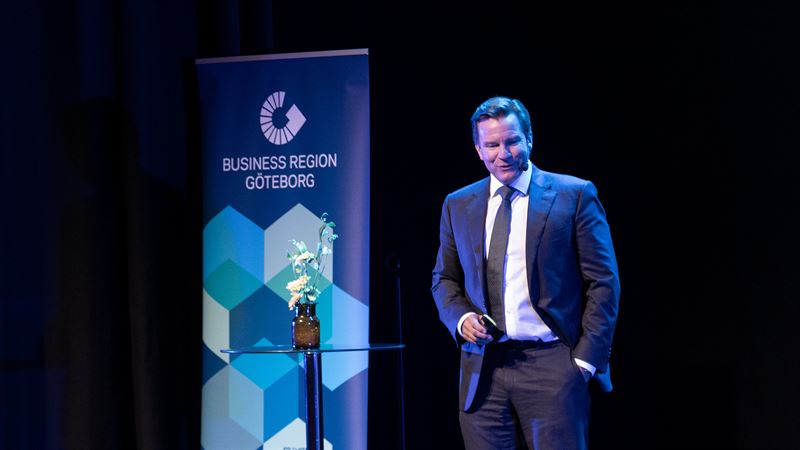
“During the last two years, the Nordic countries have seen fairly strong growth, at least from a European perspective, though they have been outgrown by the US. And looking ahead, more or less all the Nordic countries will grow faster than the other European countries,” said Jens Magnusson, Chief Economist at SEB.
In connection with the Nordic Compass Summit, held in Gothenburg on 4-5 November, Jens Magnusson set the scene for business and political leaders. He was part of the Economic Outlook seminar, arranged by Business Region Göteborg, held prior to the summit’s opening ceremony. It was attended by both summit delegates and leaders from Gothenburg’s business community.
He highlighted that in recent years, several of the Nordic countries have seen strong exports and strong industrial production. Household consumption has been a little hesitant, but has been improving.
He also explained that the Nordic countries on their own are quite small, but together they form a mid-sized economic power.
“Together we are a rather large economy - a 2 trillion-dollar economy - placing us around the 11th or 12th largest. It makes sense to start thinking about us as a unified region rather than five separate countries,” said Jens Magnusson.
While economic performance is currently quite strong in the Nordic countries, he explained that in the long term “it’s about competitiveness. It’s about productivity and innovation,” he said.
In terms of the UN’s Human Development Index, which is based on health and longevity, knowledge and standard of living, the Nordic region is a strong performer. Five Nordic countries are in the top 12.
Another strength, according to Magnusson, is that the Nordic countries are characterised by strong public finances, where government debt levels are relatively low.
In addition, he highlighted the relatively high-level of research and development spending as a share of GDP, as well as a strong capacity to innovate. Three Nordic countries are in the top ten in the world, according to the UN’s Global Innovation Index. Sweden, for example, is ranked second.
“We are the global leaders in a number of areas: medicine, telecom, IT, machinery, shipping, forestry, mining, tech, AI, defense, design, culture, music exports. You name it, we have it. Together between the five of us, we are a leading force in many of these areas that will be very important for the future,” said Jens Magnusson.
At the same time, he highlighted an important challenge.
“We have a tendency in the Nordics, which is too strong, that we come up with these great ideas in all these different areas. But when we reach a certain size, many companies start looking at the US to find a deeper and more productive capital market where they can finance themselves. This is clearly something that we have to address, and I think this forum is a great place for it,” he said.
Overall, his take-home message was that the Nordic countries are performing well by international standards. But there are challenges.
The Nordic countries face a changing geopolitical landscape, marked by rising global tensions, evolving trade and security dynamics, and growing competition for technology, capital and resources.
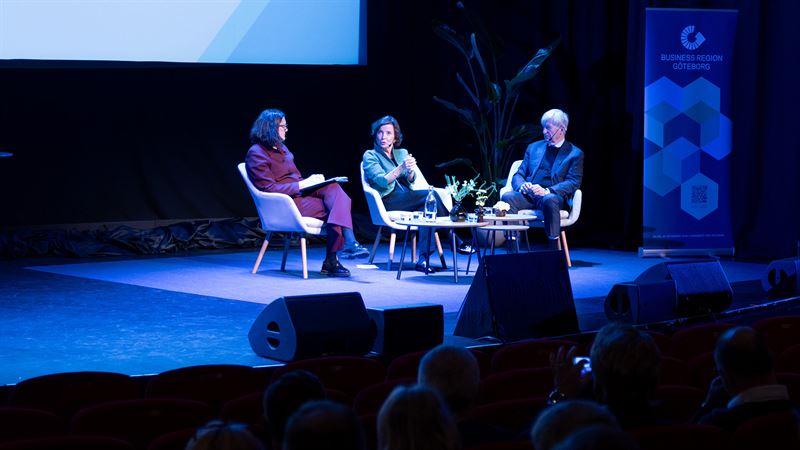
“We are in a unique position in this region, but we are losing pace. This is a moment where we cannot rest on our laurels,” said Karen Ellemann, Secretary General of the Nordic Council of Ministers.
Karen Elleman was part of the panel that rounded up the economic outlook seminar, together with the former European Commissioner for Trade Cecilia Malmström and Swedish Industrialist Carl Bennet.
Karen Ellemann sits on the advisory board of the business-led Nordic Compass initiative. She believes it will complement the long-standing governmental cooperation between the Nordic countries. It will provide leaders with specific recommendations on what is needed to build strength and resilience.
She also emphasised the strong foundation on which the Nordic region is built. What makes the region special, according to Elleman, are the similarities in the societal models in the Nordic countries. They have very strong institutions, strong democracies and strong cooperation. Trust is the “Nordic gold”.
“Just look at who has joined Nordic Compass: competitors from industry really wanting to be frank and open at the same time,” she said. “And look at our prime ministers. Look at the heads of state. They are friends. They are talking to each other all the time,” she added.
Carl Bennet provided a business perspective. He also believes the Nordics hold a strong position and sees knowledge, flexibility and openness as the region’s competitive edge.
At the same time, he would like to see more ambitious investments in strategic areas, including research and development.
“Sweden, Denmark, Norway and Finland invest a lot in research and development. But we are competing with countries which are ten times bigger and a hundred times bigger. So, I think we must invest much more to stay competitive,” he said.
Carl Bennet welcomes the Nordic Compass initiative and the potential missions that emerge in the areas of capital markets, energy, technology and defence. He believes that these can provide practical examples of how to accelerate deregulation, strengthen capital markets and create a larger integrated energy market, which in turn can further strengthen competitiveness in Europe as a whole.
“Let’s see the Nordic region as the opportunity to obtain strength. But we should also see it as a part of our involvement in the European Union, because the European Union has contributed greatly to our strength,” said Carl Bennet.
“We need scale, we need standards and we need speed.”
About Nordic Compass
Nordic Compass is an industry-led alliance that was launched in May 2026. It now has 40 Nordic companies and foundations committed to strengthening the region's competitiveness and resilience. Among the alliance partners are companies with large operations in Gothenburg, including Saab, Ericsson, Carl Bennet AB, SKF and Volvo Group. The inaugural Nordic Compass Summit took place in Gothenburg on 4-5 November. The city will also host the next summit in November 2027.
You might also be interested in
Watch the economic outlook seminar from Nordic Compass Summit
This year's economic outlook seminar, held on 5 November, was organised in collaboration with the Nordic Compass Summit, giving the programme a stronger Nordic perspective. In addition to an analysis of the economic situation in the Nordic countries and the Gothenburg region, the audience was offere…
Can the Nordic Region become Europe's growth engine?
Cecilia Malmström, Carl Bennet and the Nordic Council of Ministers' Karin Elleman will discuss this topic on Thursday 5 November in Gothenburg, during Economic Outlook – a specially designed Nordic economic seminar arranged by Business Region Gothenburg. The seminar begins the day that continues wit…
A newly formed Nordic industry alliance takes off in Gothenburg
Today, leading Nordic companies and foundations announce the establishment of Nordic Compass, a new pan-Nordic industry alliance for resilience and competitiveness. The ambition is to move faster than current European process and turn Nordic industrial strengths into concrete initiatives, aligned be…